The aim of this article is reviewing the criteria for the identification of an optimal location in territorial terms, both urban amenities (health care centers, educational centers, public parks, sport centers, public food markets, communal centers and others); and infrastructure (roads, ports, airports, communications and others).
Urban amenities and infrastructure are urban services, despite the adjective, their endowment is not only for cities; both the urban and rural areas, need different health care, education, energy, sanitation, communication or any other services. This paper will review an approach to a methodology to identify efficient locations for urban amenities or infrastructure based on land use and occupation and the flow of economic activities and the mobility of people. This will be reviewed:
- Conceptual instruments of territorial analysis; and
- Spatial analysis criteria
From both we can establish the optimal location of urban amenities or infrastructure. It is necessary to clarify that this document is intended for the territorial analysis and not necessarily for an analysis at urban scale.
Conceptual tools for territorial analysis
We will review four conceptual notes, as theoretical premises that allow us structure the later analysis:
The first is a basic concept: the city is a permanent market settlement (Weber, 2014) and a service platform, which is used by the population and companies to take or offer goods and services (Jacobs, 1970). Procurement centers, markets, services platform for economic activities to generate value and / or reach their target markets.
The cities in the territory are the destination and a resting place of the territorial economic flows, in them the economic activities generate value, take services, demand financial services, generate employment, gather and transform products, trade and many thongs more; from the cities decisions are made about the development of economic activities.
The second is the relationship between the economic activities that use the resources of the territory and transform them, and the markets where they are delivered, these markets can be internal or external (whatever the space conditions for determining the internal or external) Within the province, department, basin or country, markets can be as distant as being on another continent or as local as the nearest city, economic activities travel the territory taking services, occupying population, accessing markets , generating value, producing goods and services that are delivered to the markets. This route begins where resources and inputs are taken for production, continues in the cities where the activities take services, or use them as logistics hubs or as manufacturing centers to generate and add value to products, to culminate in cities that are final markets.
The third is precisely the support that economic activities receive for urban services. This means that the markets and services offered by cities are vital to economic activities. They support logistics and other various services that allow economic activities to generate value and offer it to markets. Territorially these urban services (both as equipment or infrastructure) have a service area, which generally does not cover the all country’s territory, leaving portions of it, as well as diverse resources, are not attended and with difficulties to generate economic activities and wealth.
The fourth is to determine the type of management of urban services: public or private, or how much part of one or another. It’s quite understandable that in those territories where economic activities are prosperous, the volume of demand for them and the value of goods and services in the market determinate conditions for a private supply of services. However, in those where the activities do not generate a significant amount of value, because of the subsidiary nature of the state, we will have to consider that it is the one who implements the necessary services for the promotion of private economic activities and when they generate a significant demand to transfer the management of services to the private sector. Likewise, the public sector should intervene when the markets of urban services generate some type of distortion that affects the efficiency of the markets. Of course in the middle are the Public Private Partnerships, which require a fine analysis of the investment opportunity and the future benefits of it. However, this assessment is done in thick terms, and in a territory as diverse, complex and rugged as the Peruvian. We can design a series of solutions that should accommodate the size of economic activities, economic-territorial relationships (sometimes even pre-capitalist), social conditions, informal, para-formal or openly illegal economic activities and a very long etcetera.
Knowing how these elements are related, we can identify the territorial processes by which economic activities, markets and urban services are related; therefore, it will be possible to identify which interventions can be done, both in terms of public investment and private initiatives.
Criteria of Spatial Analysis
The identification of an optimal location could be developed from these four criteria; some of them can be implemented in a qualitative way; however, a greater clarity in the analysis can only be obtained from a quantitative analysis.
Criterion of density of urban centers
Urban services develop economies of agglomeration among them, so that the more they exist, the greater the impact in terms of welfare for the population or the improvement of the productivity of economic activities.
In this sense, the implementation of a new urban service will have a greater impact in the presence of other urban services than in being alone. For example, if there is a road, placing a medical post or an initial center generates that the scope of the equipment is greater. Likewise if we have a public supply market its operation will depend on counting electric power and sanitation.
This density of urban services follows the pattern of human settlements in the territory because just as it was said at the beginning of this document, cities are centers of services, and therefore a location with a greater marginal impact will be which takes advantage of the presence of other services which can generate synergies.
Criterion of spatial relationship between resources and economic activities
The territory is crossed by diverse flows, one of them is the route of the economic activities, which in their territorial trajectory they cross different parts of the space, taking resources, or services or acceding to markets, generating tensions between diverse portions of the territory, among which it develops its activities. The territory in this sense is a constant crossing of economic flows; some of these will take certain services, some public, others private.
The optimal location in this sense is the one that provides services to the greatest amount of economic flows.
Criterion of intervention on activities that generate greater value
Some economic activities generate more value than other activities; as a consequence their impact in the generation of territorial value will be greater. Those that generate greater value when receiving the services will be able to increase their productivity adding more value to the territory.
The optimal location in this sense is the one that provides services to the economic flows that generate greater value to the territories.
Criterion of intervention on activities with the greatest impact on the local economy
Some economic activities articulate a large number of actors in the territory, or generate a great demand for labor; consequently they are articulated to the economy of a large number of families in the territory, or demand services and goods produced locally, articulating to other economic actors in the territory; in this sense, an investment in services that impacts on these will increase not only the productivity of economic activities but will boost the economy as a whole. These activities usually have a high demand for local labor, which means that an increase in their productivity will result in an increase in the demand for local labor or an increase in the wage.
An optimal location in this sense is the one that provides services to the economic activities that have a greater articulation to the families and / or local producers.
As a conclusion: targeting public investment and private investment opportunities.
In public terms, applying these principles and criteria will allow the creation of greater conditions to promote investment efficiency; however, as stated earlier, the greatest impact of investment in urban services is given when these investments are concentrated in the territory generating economies of agglomeration. Nevertheless, this is very difficult to implement at the public level, due to the sectorial separation of investments. In order to agree to different ministries, a very strong and intelligent inter-sectoral coordination is needed. In theory, this should be done by local and regional governments, through their territorial plans (in this respect see this entry of this same blog – in Spanish).
In private terms, applying these principles would help identify the best served areas; thus the places with greater facilities for production, in which the return of investments may have less uncertainty; or where there are those places with less exploited resources; hence with a market of less developed factors where the impulse of a great investment could generate great returns in prolonged periods.
Bibliography
Camagni, R. (2005). Economía Urbana. Barcelona: Antoni Bosch Editor
Jacobs, J. (1970). The Economy of Cities. New York: Random House Inc.
Weber, M. (2014). Economia y Sociedad (3ra.). Mexico: Fondo de Cultura Económica.
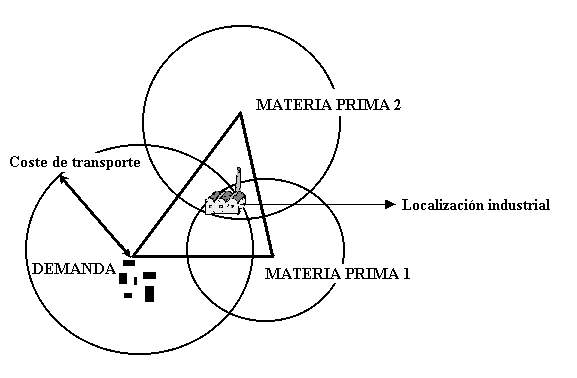
About the header image: it’s an explanation of Alfred Weber’s Industrial Location Model, taken from Isaac Buzo Sanchez’s blog “Apuntes de Geografía Humana”. Although not exactly the subject of this entry, the theoretical criteria and bases do not differ to much from what is presented here.
This English version was revised by Miss Vanessa Montero.
 Urbanismo y Economia